Essentials of Forgiveness
The Amazing Dignity of Bishop James Healy
(CATHOLIC DIGEST May 2110)
By Mary L. Stough
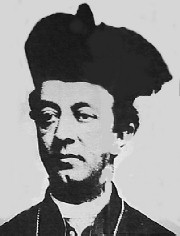 Father
James Healy was supposed to be relaxing during this 1870s Maine summer, but here
he was, conducting a catechism lesson for neighborhood children. Though Healy
was on vacation from his parish duties in Boston, he could not ignore the
fact that the religious education of these young St. Denis parishioners
was being neglected. These were the children of Irish immigrants. As the eldest
son of an Irish immigrant himself, Healy understood all too well that society
had relegated these recent immigrants to the lowest rung on the social ladder.
The only class lower than the Irish at that time were blacks, like his mother.
James Healy was one of eight children. His father, Michael Morris Healy, was an
Irish immigrant who had become a wealthy landowner in Georgia, with large
acreage in cotton and 49 slaves. His mother was Michael Heal/s mulatto slave
wife, Eliza Cark Healy. Since Eliza Clark Healy had been born into slavery, all
the children from her marriage were—bylaw—also condemned to a lifetime of
slavery. Healy could not have known the future, that a war would free the
slaves. He by no means intended to leave his children's lives to chance or
slavery. As each of their sons came of school age, he was quietly taken north,
baptized, and then educated to take his place in a free society. The four Healy
brothers, Michael, James, Patrick, and Sherwood, all were enrolled in the newly
founded Holy Cross College in Worcester, Massachusetts. The youngest, Michael
made his career in the Cutter Service (now the Coast Guard). He, like his
brothers, was light complexioned and so decided to pass for white; it was the
only way he could advance to the rank of Captain. The other brothers chose their
careers in the Church. Patrick became a Jesuit priest and the president of
Georgetown University, Sherwood a priest in the Boston diocese, and James, after
ordination in 1854, served in Boston as the bishop's secretary, then as
chancellor, cathedral rector, and finally as pastor of St. James Church. The
brothers' racial origins were known only to close friends and their superiors in
the Church. Feeling rather good about his session with the children, Father
James Heal/was unprepared for the angry reaction from the St. Denis
pastor the following day. The priest was apparently upset about the
"strange priest" who took it upon himself to instruct the young
parishioners.
Father
James Healy was supposed to be relaxing during this 1870s Maine summer, but here
he was, conducting a catechism lesson for neighborhood children. Though Healy
was on vacation from his parish duties in Boston, he could not ignore the
fact that the religious education of these young St. Denis parishioners
was being neglected. These were the children of Irish immigrants. As the eldest
son of an Irish immigrant himself, Healy understood all too well that society
had relegated these recent immigrants to the lowest rung on the social ladder.
The only class lower than the Irish at that time were blacks, like his mother.
James Healy was one of eight children. His father, Michael Morris Healy, was an
Irish immigrant who had become a wealthy landowner in Georgia, with large
acreage in cotton and 49 slaves. His mother was Michael Heal/s mulatto slave
wife, Eliza Cark Healy. Since Eliza Clark Healy had been born into slavery, all
the children from her marriage were—bylaw—also condemned to a lifetime of
slavery. Healy could not have known the future, that a war would free the
slaves. He by no means intended to leave his children's lives to chance or
slavery. As each of their sons came of school age, he was quietly taken north,
baptized, and then educated to take his place in a free society. The four Healy
brothers, Michael, James, Patrick, and Sherwood, all were enrolled in the newly
founded Holy Cross College in Worcester, Massachusetts. The youngest, Michael
made his career in the Cutter Service (now the Coast Guard). He, like his
brothers, was light complexioned and so decided to pass for white; it was the
only way he could advance to the rank of Captain. The other brothers chose their
careers in the Church. Patrick became a Jesuit priest and the president of
Georgetown University, Sherwood a priest in the Boston diocese, and James, after
ordination in 1854, served in Boston as the bishop's secretary, then as
chancellor, cathedral rector, and finally as pastor of St. James Church. The
brothers' racial origins were known only to close friends and their superiors in
the Church. Feeling rather good about his session with the children, Father
James Heal/was unprepared for the angry reaction from the St. Denis
pastor the following day. The priest was apparently upset about the
"strange priest" who took it upon himself to instruct the young
parishioners.
Father Peterson, no man to mince words, bellowed his displeasure at Healy.
Just who did he think he was, coming here from Boston with his big-city ways? If
he. Father Peterson, needed help with his parish, he knew how to ask for it. And
when he did, it wouldn't be from a man with the slightly darker complexion and
jet-black hair, thank you!
Healy, taken completely aback, apologized. But Peterson was not placated and
threatened to denounce the interloper. No amount of explanation or begging from
Healy would change Peterson's mind.
And so, on the following Sunday, Peterson mounted the pulpit in a great rage.
The gossip about the incident had already circulated throughout the parish. The
congregation sat with attention riveted on the pastor. The priest's face
mirrored his emotions as he pounded the pulpit. He made it clear that he would
not tolerate any outside interference at St. Denis.
"Especially," he thundered, "I do not want anyone
with 'indelicate blood' instructing the parish children." There, he'd
said it! Everyone sat stunned. Father Peterson had his revenge.
The years passed. In April 1875, the new bishop-elect, James Healy, traveled
through Maine to acquaint himself with his new diocese. And when he did,
memories of an unpleasant incident came flooding back.
Healy wasn't the only one who remembered. When Father Peterson, still a
pastor in the diocese, found that Healy was about to become his bishop, he sent
in his resignation. But Healy refused to accept it. As humiliating as the memory
was, now was the time to show that the bishop was a person who could not only
forgive but also forget.
Peterson was currently pastor of the church at Rockland. His meeting with the
bishop-elect, strained as it was, was reassuring. Peterson realized the new
bishop was a priest of character and forgiveness far surpassing his own. And, to
his own relief, Healy realized that he had the loyalty of the now-chastened
pastor.
Healy, however, had one more item of concern. Curiosity, perhaps, was the
parishioners' reaction as their new bishop mounted the St. Denis pulpit in
North Whitefield, where he'd once suffered the indignity of racial
denunciation at the hands of Father Peterson. Curiosity, perhaps, was the
parishioners' first response, but genuine affection and respect followed.
In his first pastoral letter, Bishop Healy commented on the wonderfully
hospitable welcome he'd received in his new diocese. Then, he laid out the rules
and regulations. But he reserved special emphasis for a long-neglected bit of
unfinished business.
"I request you to consider," he commented, "that to
denounce by name is like arbitrary and therefore unjustifiable
excommunication.... The almost inevitable result of denunciation is to
extinguish whatever little faith is left in the heart of the denounced person,
and to wound the feelings of friends and relatives."
For the next 25 years, Bishop Healy ran his diocese with meticulous care for
his flock. He never again referred to the degrading treatment he'd received at
the hands of Father Peterson, not even indirectly. And the people of the Diocese
of Portland quickly came to regard him as one of their own.
The matter of the bishop’s complexion was never referred to again.
CD
From CATHOLIC DIGEST May 2110
return
to the newsletter